
How it works
Each year, the International Transactions Clinic enrolls about 14 Michigan Law students, each handling two to three live matters involving startup or impact investment fund financing, governance, due diligence, term sheets, agreements, and cross-border regulatory questions. Together, they support more than 20 client matters each academic year.
“On the one hand, they are learning very important legal skills,” Dickinson said, “but they’re also learning client management skills through interactions in real-life situations.”
“Actually drafting the contracts, drafting the policies is something that you don’t often get to do in law school,” said Madi O’Hara, a Michigan Law student.
Suji Kim, another student in the clinic, said the experience offered a window into the collaborative nature of transactional practice.
“I liked working in a more collaborative setting, working to reach agreements, which is a lot of what transactional attorneys do,” Kim said.
The clinic also emphasizes opportunities for students to meet clients where they work, including through international travel. In recent years, student teams have traveled to countries including Ethiopia, Kenya, Rwanda, Costa Rica, and Argentina, sometimes alongside Michigan Ross business school students and clients.
Dickinson said those experiences are an important part of helping students understand the real-world context behind the legal work.
“We believe that it is very important for our students to get out into the field and to actually see what’s going on with our clients in their home space,” Dickinson said. “We hope to be able to expand those opportunities for our students in the future.”
“These opportunities have been supported in part by alumni donors, including the Chemtob family, whose generosity has helped the clinic expand students’ ability to work with clients beyond Ann Arbor.”
Legal support with human stakes
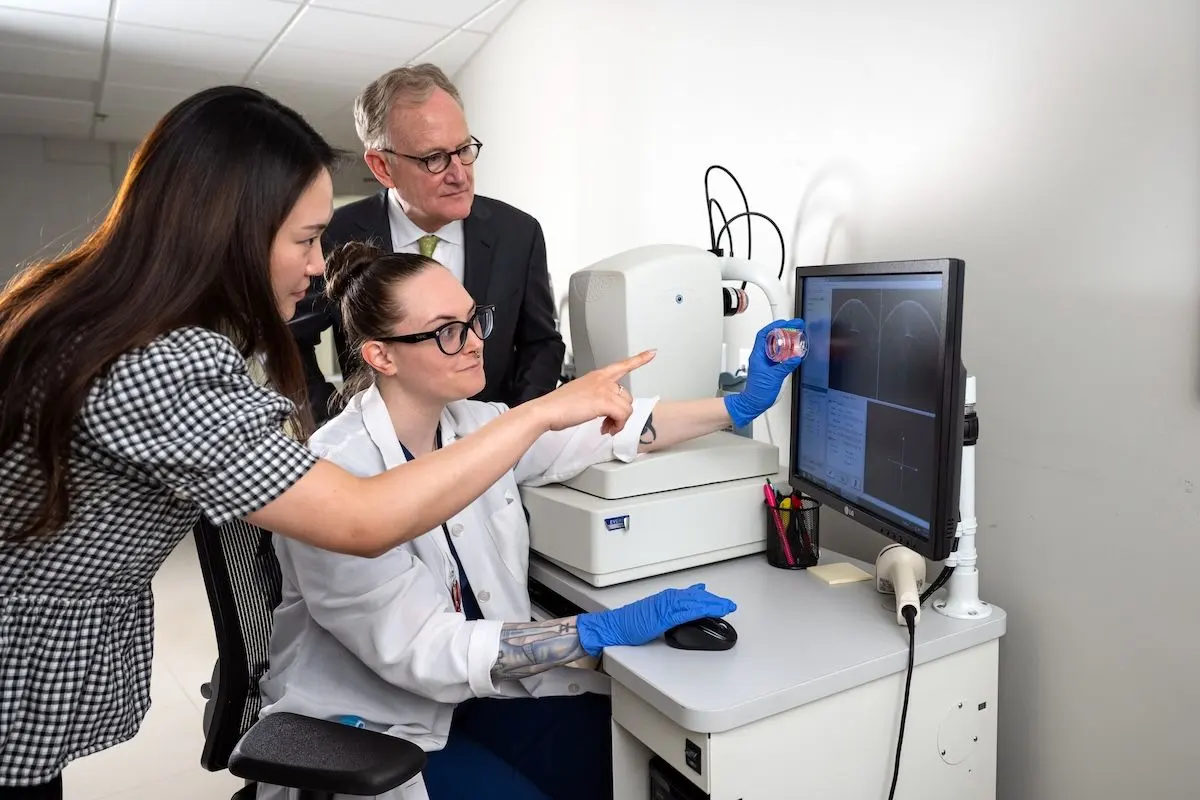
The clinic has assisted Eversight Vision, a global nonprofit eye bank, with regulatory and logistical requirements for providing cornea tissue for transplants, benefiting injured veterans in Ukraine. For Dickinson, Eversight represents the kind of client the clinic was created to serve.
“Eversight was the perfect type of entity for the clinic because they needed help with legal matters relating to their international expansion, and it was the type of mission that the clinic was set up to assist,” he said.
The relationship also gives students a chance to see the human impact of their legal work. Each fall, Dickinson takes students to Eversight to meet the client and tour its facilities.
“It’s wonderful for our students to be able to work with that type of an entity and to feel like they are part of the restoration of people’s sight around the world.”
For Eversight, the clinic’s support has expanded what the nonprofit can accomplish outside the United States, including in Ukraine.
“The assistance of the ITC, through the law school, really unlocked the potential for us to be able to help patients there,” said Colin Ross, vice president of global development at Eversight. “That’s been extremely gratifying for us to know that we can help there because of this partnership that we have.”
For a nonprofit, access to this kind of legal support can make a direct difference in how many people it can serve.
“To be able to receive these services pro bono through the law school, that’s an incredible gift for a nonprofit like us,” Ross said. “Again, it just extends our ability to provide care.”
Why it matters:
Affordable housing, healthcare access, clean energy and climate resilience Affordable housing, healthcare access, clean energy, and climate resilience depend on more than good intentions. They require legally sound, financially workable, and ethically structured agreements that allow organizations to act with confidence.
By providing pro bono support, U‑M’s International Transactions Clinic helps clients manage risk, reduce burdens, and move promising ideas toward implementation. At the same time, Michigan Law students gain practical experience on complex international matters — preparation they can carry into law firms, nonprofits, social enterprises, and impact investing.
Through the clinic, Michigan Law is helping turn mission-driven ideas into legally sound projects beyond borders while training the next generation of lawyers to lead with purpose.